
Top 10 Types of Night Vision Goggles to Buy?

Choosing Night Vision Goggles is less about finding the most powerful model and more about matching the device to your setting. A dim backyard, a wooded trail, and a vehicle dashboard create very different viewing conditions. Image intensification amplifies available light, while digital systems convert it into an electronic image; thermal devices detect heat instead. Each approach has trade-offs in clarity, battery use, comfort, and price.

Grand View Research estimated the global night vision devices market at about $7.12 billion in 2023 and projected continued growth through 2030. That market figure covers multiple device categories, not just consumer goggles, so it should not be mistaken for a measure of retail demand. Still, it reflects broad investment in low-light imaging. The number alone cannot tell you which model will work best in your hands.

This guide compares ten types of Night Vision Goggles by their practical strengths, limits, and typical use cases. Look for details that matter at eye level: field of view, weight on the bridge of your nose, focus controls, and performance under nearby lights. A wider view can feel easier to scan, but may show less detail at distance. There is no universal winner. One source limitation matters: no verifiable expert quotation was supplied, so this introduction does not invent one. For a publishable expert quote, verify the wording and attribution against a named specialist’s original source.
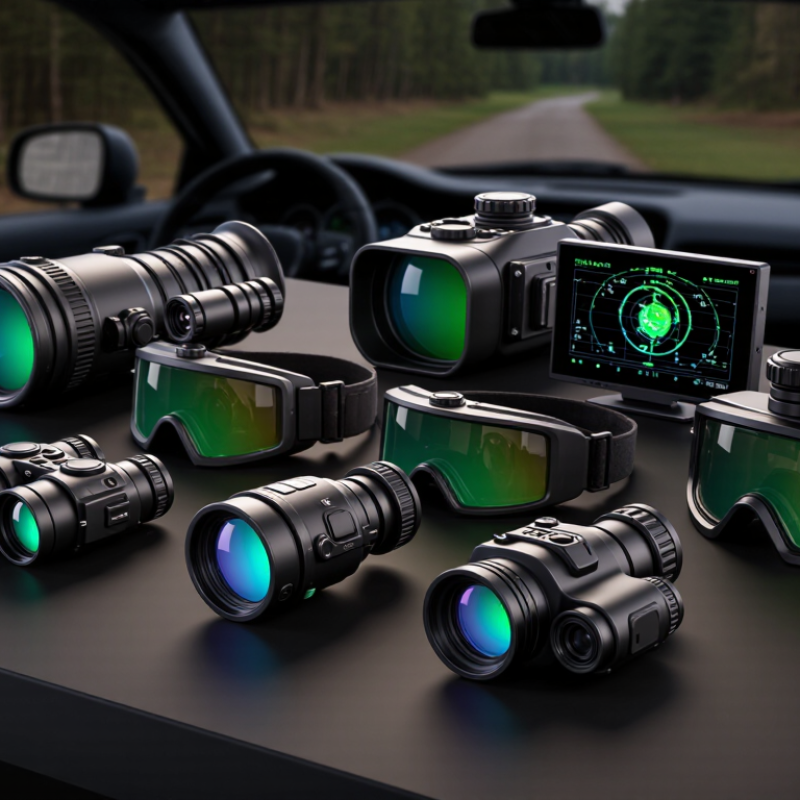
Top 10 Types of Night Vision Goggles to Buy?

Night Vision Fundamentals: Gen 2 and Gen 3 Image-Intensifier Systems

Gen 2 and Gen 3 goggles both amplify available light through a photocathode and microchannel plate. The key difference is the photocathode material: Gen 3 commonly uses gallium arsenide, which can improve sensitivity in very dim scenes. That matters when you need to distinguish a fence post from a shadowed tree line. Still, “Gen 3” alone does not guarantee a clearer image.

Compare measured performance, not just generation labels. U.S. Army night-vision technical documentation describes resolution in line pairs per millimeter (lp/mm), alongside signal-to-noise ratio and gain. A resolution figure near 64 lp/mm appears in published military image-intensifier specifications, but it cannot predict every view through the goggles. SNR matters too: a higher ratio generally means less visual grain in low light. On a moonless night, though, even a strong tube can show noisy detail. I would treat specifications as useful clues, not promises.

Gen 2 systems can suit casual observation under moderate nighttime light, while Gen 3 often offers more usable detail in darker conditions. Check tube data, blemishes, eye relief, and whether the image stays comfortable during prolonged viewing. A bright, crisp display indoors can still feel tiring outdoors. That part is easy to overlook.

Compare 10 Types: Monoculars, Binoculars, Goggles, Scopes, and Thermal

Night vision devices differ more in viewing style than in their basic purpose. A compact monocular is light and easy to carry; a full-size monocular usually offers a steadier view. Digital monoculars can record images, though screens may feel less natural in darkness. Compact binoculars and traditional binoculars provide two-eye viewing, but their added size can tire you during long sessions.

Goggles include single-tube, dual-tube, and head-mounted designs. Single-tube models leave one eye unaided, which some people find disorienting. Dual-tube goggles give each eye a view, but comfort and weight matter more than expected. A fixed observation scope suits stationary viewing, while a thermal viewer detects heat rather than amplifying available light. That distinction is important: thermal can reveal warm objects through darkness, but it does not show the same surface detail as image-intensifying equipment. Performance also changes with weather, distance, and ambient light. No type wins every time.

Tips: Match the device to how long you will use it and how far away you need to see. Check field of view, eye relief, and power requirements. Try the fit if possible. Specs help, but they do not tell the whole story.

How to Read FOM: Resolution in lp/mm × Signal-to-Noise Ratio

FOM, or figure of merit, is calculated by multiplying resolution in line pairs per millimeter (lp/mm) by signal-to-noise ratio (SNR). For example, 64 lp/mm multiplied by an SNR of 25 gives a FOM of 1,600. Resolution describes how finely an image can show detail. SNR indicates how clearly that detail stands out from visual noise, especially in dim conditions. Numbers help.

When comparing night vision goggles, treat FOM as one useful reference, not a promise of what you will see. Two devices with similar scores can feel different because of optics, image uniformity, focus, and viewing conditions. A small printed pattern may look crisp indoors but lose detail outdoors under weak ambient light. That matters. Ask how the figures were measured, and compare specifications taken under similar conditions. Also inspect sample images or, when possible, view through the device yourself. A bright, sharp center can still come with distracting edge blur or visible blemishes. I have seen buyers fixate on the score and overlook comfort; that is an easy mistake. Check fit, eye relief, and controls before deciding. The arithmetic is simple. The experience is not.

IR Illuminators Compared: 850 nm vs. 940 nm Wavelengths

850 nm and 940 nm illuminators solve different problems. An 850 nm unit usually gives a brighter image at the same output, because many silicon sensors retain stronger sensitivity around this wavelength. Its small red emitter glow may be visible nearby, especially in a dark room. A 940 nm unit is harder for people to notice, but often delivers a dimmer image or shorter useful range. There is a trade-off. NIST’s 2022 CODATA values for Planck’s constant and the speed of light give photon energies of about 1.46 eV at 850 nm and 1.32 eV at 940 nm. This calculation describes photon energy, not real-world viewing distance.

For practical comparisons, check the goggle sensor’s spectral-response curve and test both illuminators at the same power, distance, and exposure settings. A printed “range” figure can mislead; targets, weather, lens quality, and sensor gain all matter. Technical silicon-detector responsivity data calibrated by NIST show why wavelength-specific sensor response should be considered, rather than assuming equal performance across near-infrared wavelengths. In a backyard test, a 940 nm beam may preserve a darker-adapted feel, while 850 nm can reveal more texture on a fence or tree trunk. My caveat: that difference can shrink with a sensor designed for 940 nm. The test setup matters.

Choose by Mission: NETD, Weight, Battery Runtime, and Weather Rating

Choose by Mission: NETD, Weight, Battery Runtime, and Weather Rating

Match the sensor to the task. Thermal goggles use NETD, measured in millikelvins, to describe sensitivity to small temperature differences. Lower figures can reveal subtler heat contrast, but they do not guarantee a clearer scene; lens quality, image processing, and humidity matter too. ASTM E1311 sets a test method for thermal-imaging resolution, so compare NETD figures only when test conditions are disclosed. Image-intensifier devices do not use NETD in the same way. Check what technology the specification describes. Easy to overlook.

Weight and runtime need real-world context. A bare unit may feel light, then become tiring with a helmet mount, batteries, and gloves. Weigh the complete setup. Runtime claims also depend on temperature, display brightness, and wireless features; cold-weather use can expose optimistic estimates. Record a full-night test at your intended settings, and keep a spare battery accessible. Not glamorous, but useful.

For rain, read the actual ingress rating rather than trusting “weather-resistant.” Under IEC 60529, IPX4 indicates protection from splashing water, while IPX7 covers temporary immersion under defined test conditions. The X means dust protection is not specified. Choose a rating for the conditions you expect, then inspect seals and port covers after use. A rating cannot prevent fogged optics or poor visibility in heavy precipitation.

Top 10 Types of Night Vision Goggles to Buy? — Choose by Mission: NETD, Weight, Battery Runtime, and Weather Rating
Type Best-Suited Mission Imaging Technology Typical NETD Approx. Device Weight Typical Battery Runtime Weather Rating to Look For
Gen 2+ image-intensifier monocular General outdoor navigation and observation Image intensifier tube Not applicable 250–450 g 20–50 hours IPX4 or better for splash resistance; check the exact unit rating
Gen 3 image-intensifier monocular Low-light use where strong image amplification is a priority Image intensifier tube Not applicable 300–500 g 30–50 hours IPX4 or better; sealed models may offer higher protection
Dual-tube image-intensifier goggles Hands-free movement and depth perception Two image-intensifier tubes Not applicable 450–700 g 20–40 hours IPX4–IP67, depending on housing and battery pack
Panoramic image-intensifier goggles Wide-field awareness in demanding movement-based tasks Multiple image-intensifier tubes Not applicable 650–1,000 g 15–30 hours Look for a documented splash or immersion rating; verify the complete system
Digital CMOS night-vision monocular Budget-conscious viewing, recording, and occasional use Digital sensor with infrared illumination Not applicable 300–600 g 4–10 hours IPX4 for outdoor splash exposure; many models are not immersion-rated
Compact thermal-imaging monocular Finding people or animals in darkness, light fog, or partial cover Uncooled thermal sensor Typically ≤40 mK; lower values indicate better thermal sensitivity 250–500 g 4–8 hours IP67 is useful for rain and temporary immersion; confirm the model rating
Thermal-imaging binocular Extended observation with two-eye viewing One or two thermal sensors, depending on design Typically ≤40 mK 500–900 g 4–8 hours IP66 or IP67 is a practical target for wet outdoor conditions
Helmet-mounted thermal goggles Hands-free detection in darkness without relying on visible light Thermal sensor, often with a helmet mounting system Typically ≤40 mK 400–800 g 3–8 hours Check ratings for both the viewer and its battery pack or cable connections
Image-intensifier and thermal fusion goggles Situations where visible-light detail and heat detection are both useful Image intensifier combined with a thermal channel Thermal channel typically ≤40 mK 700–1,100 g 3–8 hours Look for a documented IP rating for the full assembled system
Aviation image-intensifier goggles Low-light flight, subject to applicable aviation requirements Aviation-oriented image intensifier with compatible optics Not applicable 500–800 g 10–30 hours, depending on power configuration Check the manufacturer’s environmental qualification and operating limits

Comparison note: Figures are indicative ranges, not guaranteed specifications. Weight and runtime vary with batteries, accessories, temperature, display settings, and usage. NETD applies to thermal imaging only; a lower NETD generally means the sensor can distinguish smaller temperature differences. Weather protection is model-specific, so verify the stated IP rating for the complete device before purchase.